[Avg. reading time: 12 minutes]
Concurrency & Parallelism
Process
Definition
A process is an independent program in execution.
- Has its own memory space
- Is isolated from other processes
- Managed by the operating system
Examples
- Chrome browser
- VS Code
- Python script running
Each of these runs as a separate process. Processes do NOT share memory by default.
Thread
Definition
A thread is a unit of execution inside a process.
- Multiple threads can exist inside one process
- Threads share the same memory
- Managed by the OS
Key Idea
Threads are like workers inside a process.
- Faster than processes
- Can run in parallel
- But shared memory = risk (data races)
Example
A single application can have:
- UI thread
- Network thread
- Worker thread
Threads are not CPU Cores. But they use Cores
Task
Definition
A task is a piece of work to be executed.
- It is NOT tied to threads or processes
- It is an abstraction
Key Idea
A task is WHAT to do
A thread is WHERE it runs
Examples
- “Read this file”
- “Process these 1M rows”
- “Call this API”
Differences
Process
  ├── Thread
        ├── Executes Tasks
- Process : container
- Thread : worker
- Task : actual work
| Concept | What it is | Memory | Cost |
|---|---|---|---|
| Process | Independent program | Separate | High |
| Thread | Worker inside process | Shared | Medium |
| Task | Unit of work | N/A | Lightweight |
Concurrency and parallelism are both about handling multiple tasks at the same time, > but they approach the problem differently.
Concurrency
Definition
-
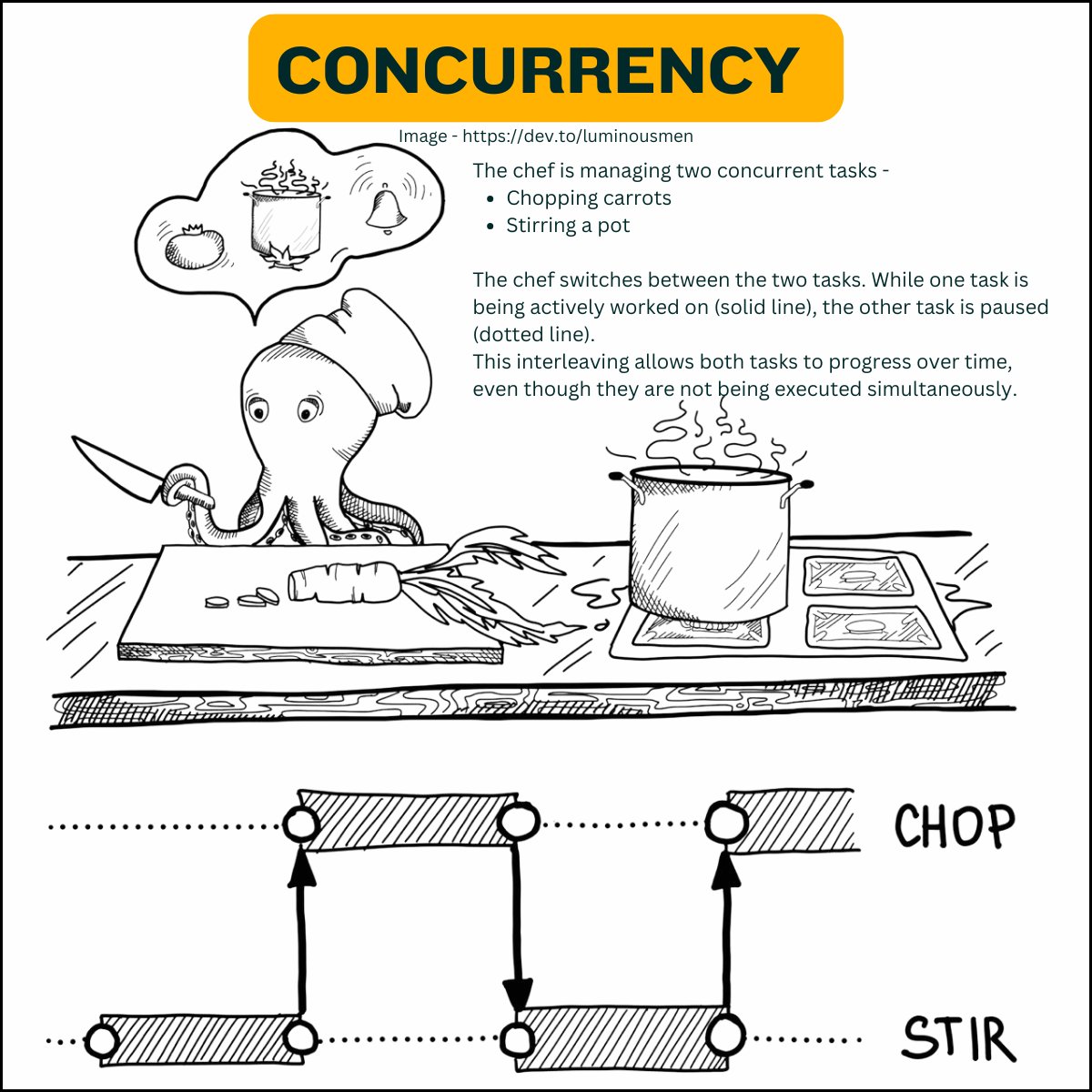
Multiple tasks are in progress at the same time
-
Not necessarily running simultaneously
-
Focus: coordination and efficient waiting
-
One CPU core
-
Task switching
-
Avoid idle time
Data Engineering Example
- Reading from Kafka
- Calling APIs
- Writing to databases
This is IO-bound work.
Parallelism
Definition
-
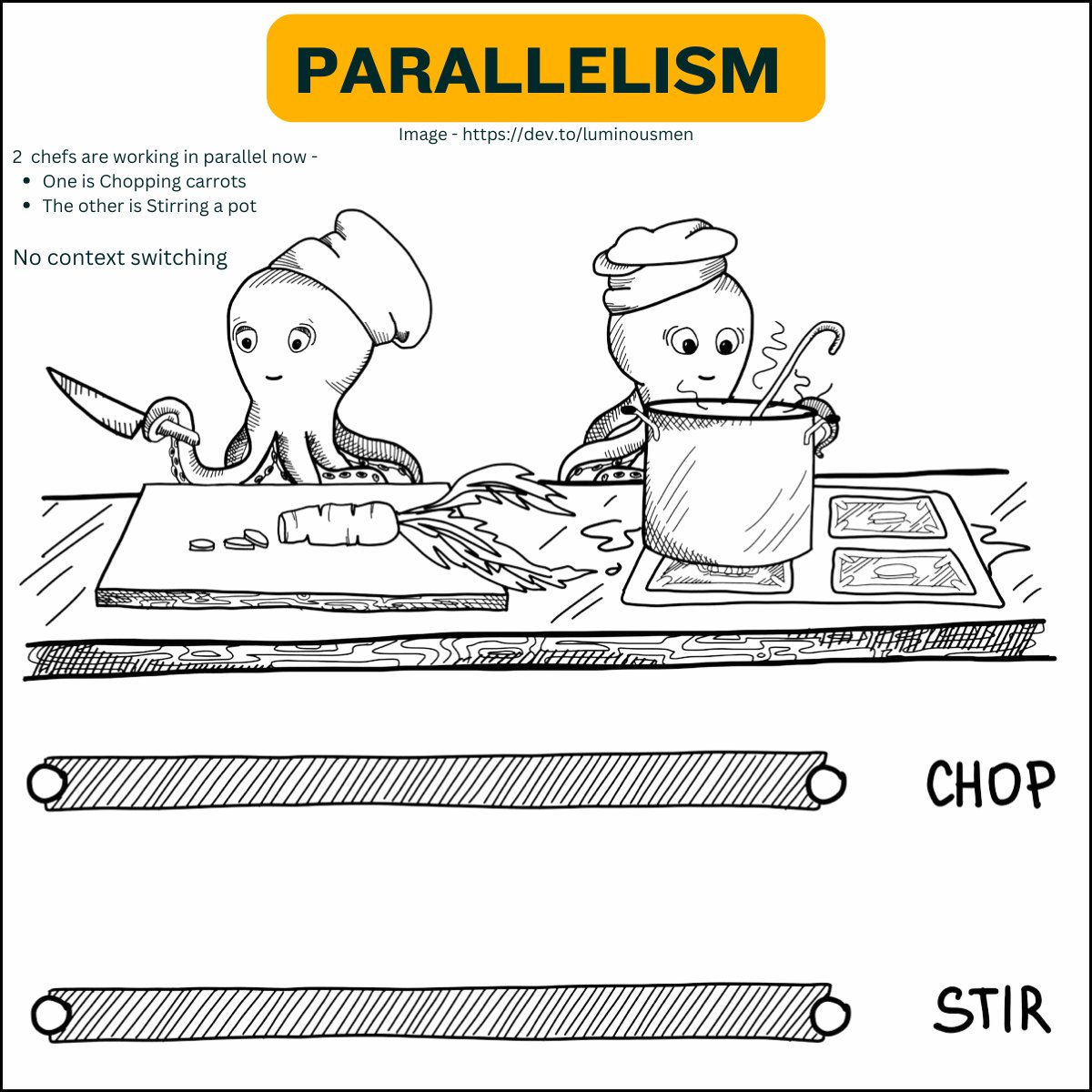
Multiple tasks executed at the same time
-
Uses multiple CPU cores
-
Focus: speed through computation
-
Many CPU cores
-
Same operation applied across data
Data Engineering Example
- Aggregations
- Filtering large datasets
- Feature engineering
This is CPU-bound work.

Key Difference
- Concurrency solves waiting problems
- Parallelism solves compute problems
Rust Implementation
Concurrency in Rust
Rust achieves concurrency through threads and async/await.
Threads: Rust’s standard library provides native support for threads, which are the basic unit of concurrency.
- True parallel execution (multi-core)
- Low-level control
use std::thread;

fn main() {
    let handle = thread::spawn(|| {
        // This is the code that will run in a new thread.
        for i in 1..10 {
            println!("Hello from the spawned thread! {}", i);
        }
    });

    // Meanwhile, the main thread continues.
    for i in 1..5 {
        println!("Hello from the main thread! {}", i);
    }

    // Wait for the spawned thread to finish.
    handle.join().unwrap();
}
Async/Await: Rust’s async/await syntax allows you to write asynchronous code that looks like synchronous code.
- Efficient for IO-bound tasks
- Non-blocking execution
use tokio; // Using the Tokio async runtime

#[tokio::main]
async fn main() {
    let future1 = async_task();
    let future2 = async_task();

    // `join!` runs multiple futures concurrently
    tokio::join!(future1, future2);
}

async fn async_task() {
    // Some asynchronous work
    println!("Doing async work");
}
Parallelism in Rust
Rust achieves parallelism primarily through the Rayon library, which provides data parallelism through easy-to-use abstractions.
Rayon: Rayon makes it easy to parallelize data processing tasks.
Key Points
Safety: Rust ensures thread safety and data race prevention through its ownership and borrowing system.
Ease of Use: Libraries like Rayon and Tokio make it easier to work with concurrency and parallelism without delving too deep into low-level details.
- Automatic parallel execution
- Ideal for data processing
use rayon::prelude::*;

fn main() {
    let data = vec![1,2,3,4,5,6,7,8];

    let result: Vec<i32> = data
        .par_iter()
        .map(|x| x * 2)
        .collect();

    println!("{:?}", result);
}
Demo
git clone https://github.com/gchandra10/rust-concurrency-parallelism.git