[Avg. reading time: 9 minutes]
Rust Overview
Rust deals with low-level details of memory management, data representation, and concurrency.
What Is Rust?
- Rust began as a personal project by an engineer at Mozilla.
- Mozilla later sponsored the project in 2009 and publicly announced it in 2010.
- The first stable release shipped on May 15, 2015.
Rust is a systems programming language designed for safety, concurrency, and performance.
It draws inspiration from:
- Systems languages such as C and C++
- Functional languages such as Haskell and Erlang
Why Rust?
-
Open Source
Backed by a large, active community with rapid iteration through nightly builds and strong industry adoption. -
Reliability
Eliminates entire classes of memory bugs at compile time through its ownership model. -
Type Safety
The compiler guarantees that operations are only performed on valid types. -
Memory Safety
References always point to valid memory, preventing null and dangling pointer errors. -
Data Race Freedom
The borrow checker enforces safe concurrency by preventing simultaneous mutable access. -
Performance
Zero-cost abstractions, no garbage collector, and minimal runtime overhead enable C and C++-level performance. -
Bare-Metal Support
Suitable for embedded systems, device drivers, and operating system kernels. -
Security
Memory safety is enforced at compile time, dramatically reducing common vulnerability classes. -
Efficiency
Enables high-performance code without sacrificing safety or expressiveness. -
Developer Productivity
Strong compile-time guarantees reduce debugging and production failures. -
Ownership-Based Safety
Achieves memory safety without garbage collection using ownership and borrowing. -
Cargo Package Manager
Built-in dependency and build management, comparable to npm or pip. -
Excellent Error Messages
Compiler diagnostics are precise, actionable, and educational. -
Efficient C Interoperability
Native foreign function interface enables safe integration with C libraries.
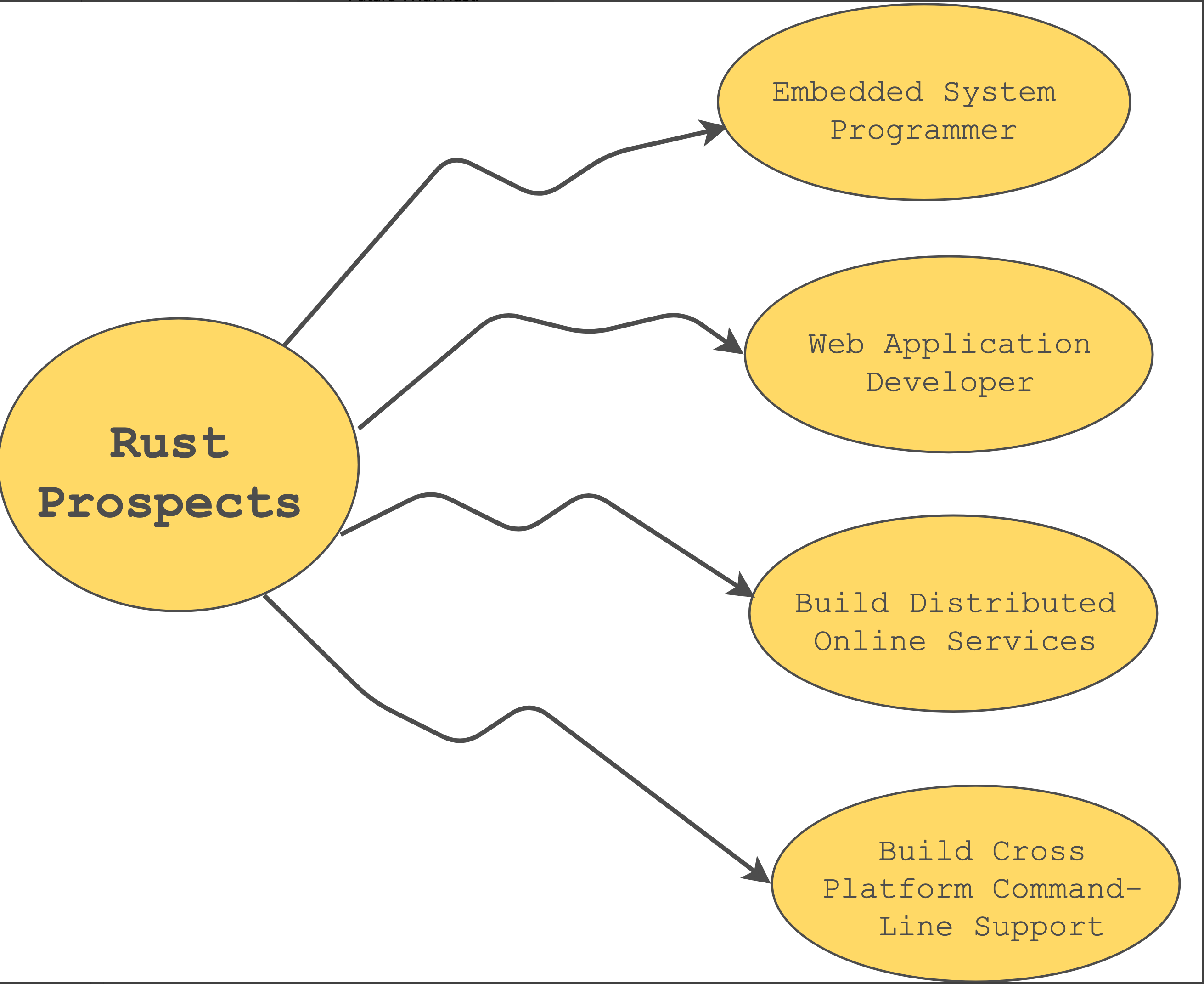
What Is Rust Used For?
Rust is well-suited for:
- High-performance web services
- Embedded and IoT systems
- Distributed and concurrent systems
- Cross-platform command-line tools
Terms to know
Crate
- a compiled Rust package or crate is a compilation unit in Rust.
- It can be a single program or a reusable library.
- Every Rust project produces at least one crate.
crates.io
- crates.io is Rust’s official package registry.
- It hosts open source Rust libraries called crates.
- Rust projects download dependencies from here by default.
rustc
- rustc is the Rust compiler.
- It converts Rust source code into machine code.
- It performs parsing, type checking, safety checks, and optimization.
This is similar to gcc, g++, javac in other languages
Who Uses Rust?
Some of the top companies listed here
- Drop Box
- Microsoft
- Discord
- Cloudflare
- Coursera
- Firefox
- Atlassian
- Amazon’s Firecracker
- Databricks
Additional Notes
- Rust is self-hosted — the Rust compiler itself is written in Rust.
- Early versions of the compiler were implemented in OCaml before the language matured.